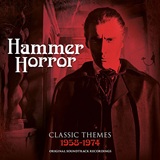
 Hammer the film production company, is virtually synonymous with Horror and was central to the careers of classical actors like Peter Cushing and Christopher Lee. Hammer films were frequently broadcast late at night on TV, when I was growing up and so I've always had a soft spot for the films. Finding a DVD box-set, I recently rewatched a large bunch of Hammer Horror movies, so Hammer films and their music has been uppermost in my mind recently. So this compilation album from Silva Screen with themes from these movies, is the perfect complement to that box-set of films and well worth a listen in its own right. The album is called "Hammer Horror" and subtitled "Classic Themes 1958-1974". This is the period covered by the album's film scores and is essentially the golden age of Hammer Horror. The compilation was released in 2017 and features original soundtrack recordings as used on the movies.
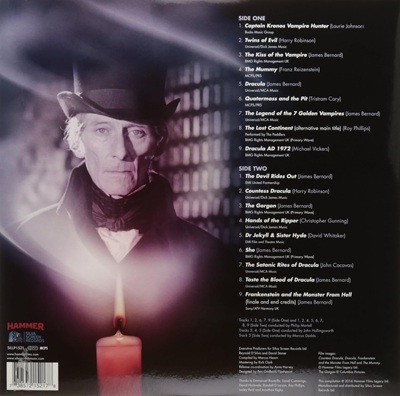
There has always been a range of possible approaches to scoring horror movies. Some scores emphasise the gothic elements, the inhuman monsters, the misuse of science, the period setting and large castles hiding who knows what secrets. For monsters in a present day setting some scores emphasise that modern setting, while other scores emphasise the emotional elements or the dramatic plot-related steps or even the heroism of those who fight the monsters. This compilation album has examples of all of these types of scores. The first track is fan favourite "Captain Kronos Vampire Hunter" and is fully in the heroic category, with composer Laurie Johnson taking an almost comic-book approach to depict the character of Captain Kronos and his ongoing fight against the undead. There are brass fanfares and galloping figures in the strings, Herrmannesque figures in the woodwind and a tortured theme on strings and oboe. "Twins of Evil" scored by Harry Robinson is also heroic in nature, and very much in the style of Morricone's well-known Spaghetti Western scores with snare drum beat, soaring trumpet and strings, rising into an heroic climax.
"The Kiss of the Vampire" introduces the composer James Bernard, so often associated with Hammer films. On this occasion Bernard delivers a 20th Century/Late Romantic piano concerto, but with just a touch of his signature atonal composition which he used on many of Hammer's vampire films. "The Mummy" by Franz Reizenstein, typically dramatic opening like the opening titles of many movies of many genres, but with ample hints of the horror to come. Then Bernard returns for the iconic "Dracula". It has often been observed that audiences generally don't like atonal music, but it is always acceptable even expected in a horror context. The scores for James Bernard's Horror movies (particularly the Dracula/Vampires ones) are the perfect example of this, and Bernard had a particular "Dracula Theme" which he re-used across several such film scores. Here is the theme in all its glory underlined with a thumping percussion!
Tristram Cary was known for his experimental electronic music and, although not part of the BBC's Radiophonic Workshop, he was the voice of the Daleks during the William Hartnell years of Doctor Who. For "Quatermass and the Pit" he created a modern orchestral score with a range of dramatic and spooky elements for this movie whose genre is a kind of sci-fi/horror crossover. "The Lost Continent" by Roy Phillips feels like a oddball when heard in this compilation. While it is a good example of a 60s-style vocal track, it differs from other tracks in this collection, since it is telling a story in words rather than through mood, atmosphere or emotion. Having said this I do like the way the music fades out in a very gradual way, like Neptune from the Planets Suite.
"Dracula AD 1972" is an obvious attempt to update the franchise from a period drama to a modern setting, and Michael Vickers delivers a score to match like a number of TV and film scores of the period. "The Satanic Rites of Dracula" by John Cacavas is also a more modern scores with a jazzy beat, though you feel that the strident quality of the Hammer Dracula is not far below the surface. Other contrasting scores on this compilation include "Hands of the Ripper" by Christopher Gunning with its lovely romantic sound again conveyed by strings, harp and flutes. "Countess Dracula" a second track by Harry Robinson also uses a softer more romantic string sound, this time with harp and cimbalom (a popular instrument at the time following its use on "The Ipcress File". "Dr Jekyll & Sister Hyde" is a great concept movie, retelling the Jekyll/Hyde story with the added twist of a gender change on top of a character change. The theme presented on this compilation is a suitably classical orchestral waltz composed by David Whitaker.
The other scores on the album are by James Bernard, and generally centred around his atonal approach though with plenty of variation as the film demands. One particular change of direction Bernard is his score for "She" with an hypnotically alluring theme for the almost god-like titular character played by Ursula Andress. It is entirely fitting that the closing track is one of James Bernard's: "Frankenstein and the Monster from Hell" and the track is identified as "finale and end credits". It starts as a low-key affair, rising in power as we hope we have seen the end of Frankenstein and his Monster - well, until the next sequel perhaps!
In summary this album delivers everything you might expect from a Hammer Horror compilation, showcasing the work of many composers and as many different scoring approaches - a great reminder of the sound of Hammer. See the CD album on Silva Screen online store, where it is currently on sale alongside. There is also a Vinyl version of the same album and this can be found at Amazon.co.uk.
 mfiles home